How Higher Axial Fan Speed Mean Greater Airflow?

In electronic devices, cooling fans are crucial components that help maintain the proper operation of the equipment. Among the key performance indicators of a cooling fan are its speed and airflow. This article explores the relationship between fan speed and airflow and discusses how to adjust the fan speed to achieve the desired cooling effect.
What is CFM?
Cubic Feet per Minute (CFM) represents the airflow, which is the volume of air a fan can move per minute. A higher CFM value indicates that the fan generates stronger airflow, allowing for quicker air circulation, making the airflow in a room more smooth and comfortable. To determine a fan's CFM value, factors such as the fan's diameter, speed, the area of the volute, and blade design must be considered. While some fans on the market come with a labeled CFM value, not all brands and models provide this information. In such cases, we can measure the CFM using a noise meter or by installing an air flow meter.
The Relationship Between Fan Speed and Airflow
Fan speed refers to the number of times the fan blades rotate per minute, measured in RPM. All else being equal, the faster the fan's speed, the greater the volume of air the blades will move (assuming the fan models are the same or similar). Although fan speed isn't directly related to fan quality, increasing speed generally results in higher airflow, but also more noise and vibration.
Higher Speed Doesn't Always Mean Better Cooling
Higher speed does not necessarily equate to better performance. While a higher speed means the fan is more powerful, it also results in greater noise. Therefore, when selecting fan speed, it’s essential to consider the specific parameters required by your product. There's no absolute rule that higher speed is better or lower speed is worse; what's important is achieving effective cooling with minimal noise. If a cooling fan's speed exceeds its standard value and operates under high load for extended periods, the heat differential may increase, ultimately leading to suboptimal cooling performance. Therefore, the idea that higher fan speed results in better cooling is not always valid.
The design of the cooling system can also affect the fan's speed. In confined and sealed environments, the fan's pressure can impact its speed. If the pressure is insufficient, the speed will significantly drop, leading to decreased airflow and reduced cooling efficiency.
The Relationship Between Airflow, Pressure, and Speed
There is a calculable relationship between airflow, pressure, and speed, which can be expressed using the following formulas:
Q1/Q2 = n1/n2
H1/H2 = (n1/n2)^2
N1/N2 = (n1/n2)^3
H1/H2 = (n1/n2)^2
N1/N2 = (n1/n2)^3
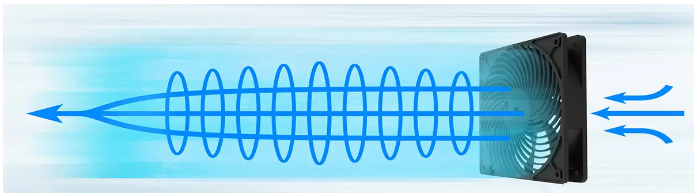
In these formulas, "n" represents speed, "N" represents the fan's power, "Q" represents airflow, and "H" represents pressure. In practical use, for fans of the same size, the airspeed is inversely proportional to the pressure. As the airspeed increases, airflow also increases, but pressure decreases accordingly. This reduction in pressure may prevent the airflow from fully reaching the base of the heat sink, causing heat to accumulate at the bottom and weakening the cooling effect. Therefore, if you need to increase both airflow and pressure simultaneously, the only solution is to increase the fan's size.
However, increasing the fan size brings a series of problems, such as excessive weight. Ultimately, the best approach is to find a balance based on your product's specific needs. It’s not always beneficial to simply pursue higher speed; the choice should be made according to your product's requirements.
Chenggaoda(CGFAN) is source cooling fans Manufacturer and supports customized, accept OEM& ODM orders. offering enterprises intelligent, energy-saving, and high-tech products. So far, CG Fan has obtained 12 patents. Visit our website://www.cgdfan.com for more information.
What is a PWM Fan
What is Inverter Cooling Fan