What is a Blower

Blower is a device that increases gas pressure and transports gas through mechanical action, widely used in industrial production and civil applications. Its core function is to generate airflow via the rotation of impellers or rotors, achieving pressurization, ventilation, cooling, or exhaust purposes.
Blowers typically consist of the following key components:
Motor: Provides power to drive the rotation of the impeller or rotor.
Impeller/Rotor: The core component that compresses gas through rotation. Centrifugal blowers use high-speed impellers to generate centrifugal force, while Roots blowers rely on the meshing of two or three rotors to alter chamber volume.
Air Filter: Filters incoming gas to prevent impurities from damaging internal components.
Casing: Guides airflow direction and protects internal parts. The volute design in centrifugal blowers aids in converting kinetic energy into static pressure.
Lubrication System: Some blowers (e.g., sliding vane types) utilize pressure differentials for automatic lubrication, reducing friction and noise.
Impeller/Rotor: The core component that compresses gas through rotation. Centrifugal blowers use high-speed impellers to generate centrifugal force, while Roots blowers rely on the meshing of two or three rotors to alter chamber volume.
Air Filter: Filters incoming gas to prevent impurities from damaging internal components.
Casing: Guides airflow direction and protects internal parts. The volute design in centrifugal blowers aids in converting kinetic energy into static pressure.
Lubrication System: Some blowers (e.g., sliding vane types) utilize pressure differentials for automatic lubrication, reducing friction and noise.
Why Choosing the Right Blower Type is Critical
Blowers may seem simple in appearance and operation, but selecting the appropriate type for specific applications is essential. Otherwise, you may compromise blower performance and/or incur unnecessary energy costs.
Centrifugal Mini Blowers
Embedded in precision equipment. High-speed impellers generate centrifugal force, drawing gas axially and accelerating it radially. Kinetic energy is converted into static pressure for pressurization.

Brushless DC Blowers
Utilize three-phase brushless motors with PWM speed control (500–25,000 rpm), offering ±1% control accuracy. Ideal for scenarios requiring precise airflow regulation

Magnetic/Air Suspension Technology
Henan Nuoshui Environmental Protection’s patented small air suspension blowers employ liquid-cooled components for oil-free operation. Models below 100mm in diameter can operate continuously for 50,000 hours.
Industrial Applications and Selection Guide
Semiconductor Manufacturing: φ62mm magnetic levitation blowers deliver clean gas in lithography machines, preventing nanoscale contamination.
Medical Equipment: 100mm centrifugal blowers provide ±0.5°C precision airflow for PCR instrument temperature control.
New Energy: 70mm brushless blowers drive hydrogen circulation in fuel cells (pressure ratio: 1.25), compatible with vehicle systems.
Smart Robotics: 50mm mini blowers manage joint cooling and sensor airflow with PWM intelligent speed control.
Maintenance Tips
Regular Cleaning: Clear impeller dust accumulation every 500 hours (e.g., in telecom equipment blowers) to maintain efficiency.
Lubrication Management: Double ball bearings require grease replenishment every 3,000 hours.
Conclusion
Miniature blowers play a pivotal role in industrial miniaturization and precision trends. Selection must balance flow rate, pressure, medium properties, and spatial constraints.
CG Fan specializes in developing and providing cooling system solutions, offering enterprises intelligent, energy-saving, and high-tech products. So far, CG Fan has obtained 12 patents. Visit our website //www.rdfans.com/ for more information.
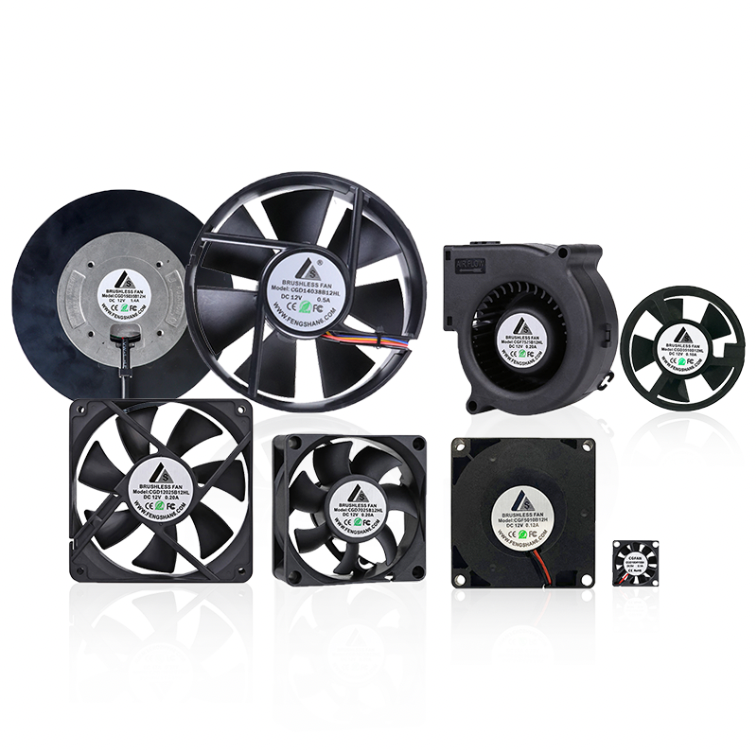
Micro Cooling Fans for Electronics